
A fingerprint rejection notice after you’ve already been fingerprinted is one of the most frustrating delays there is — it holds up your job start, your license, or your application, and usually means coming back to do it again. In our Kansas City office we capture and submit prints every day, and here’s the reassuring part: nearly every rejection traces back to a few specific, preventable causes. Here’s what actually causes one and how to clear on the first try.
First, the two kinds of fingerprint rejection
Knowing which you got tells you how to fix it. A quality rejection means the ridge detail was too faint, smudged, or distorted for the FBI’s automated system to read. A data rejection means the prints were fine, but something on the submission — a name, date of birth, the reason for printing, or the receiving agency’s code — was missing or didn’t match. The fixes are completely different, so always read the notice to see which it was.
How often do prints actually get rejected?
This is where the capture method matters enormously. According to the FBI’s published civil-fingerprint guidance, the rejection rate for Live Scan fingerprinting is generally under 1%. Industry estimates put ink-card rejections far higher — commonly in the 7–10% range — because there’s no quality check until the card is processed. In plain terms: electronic capture rarely bounces; mailed ink cards bounce several times more often.
Why prints come back for quality
From what we see in the office, quality rejections almost always come down to the skin and the roll:
- Dry or cracked skin — the single most common cause; dry ridges don’t make clean contact.
- Worn ridges — common with manual trades (construction, healthcare, cosmetology), frequent paper or chemical handling, and naturally with age. Some medications, and chemotherapy in particular, can temporarily flatten ridge detail.
- Too much pressure or movement during the roll, which smears the impression.
- Lotion, residue, or moisture on the fingertips at capture.
We see this firsthand: a client coming straight from a shift handling drywall or cleaning chemicals will often have temporarily worn ridges that read poorly. The same person, prepped properly a day later, captures cleanly. That’s why preparation matters as much as the equipment.
How to pass on the first try — printable checklist
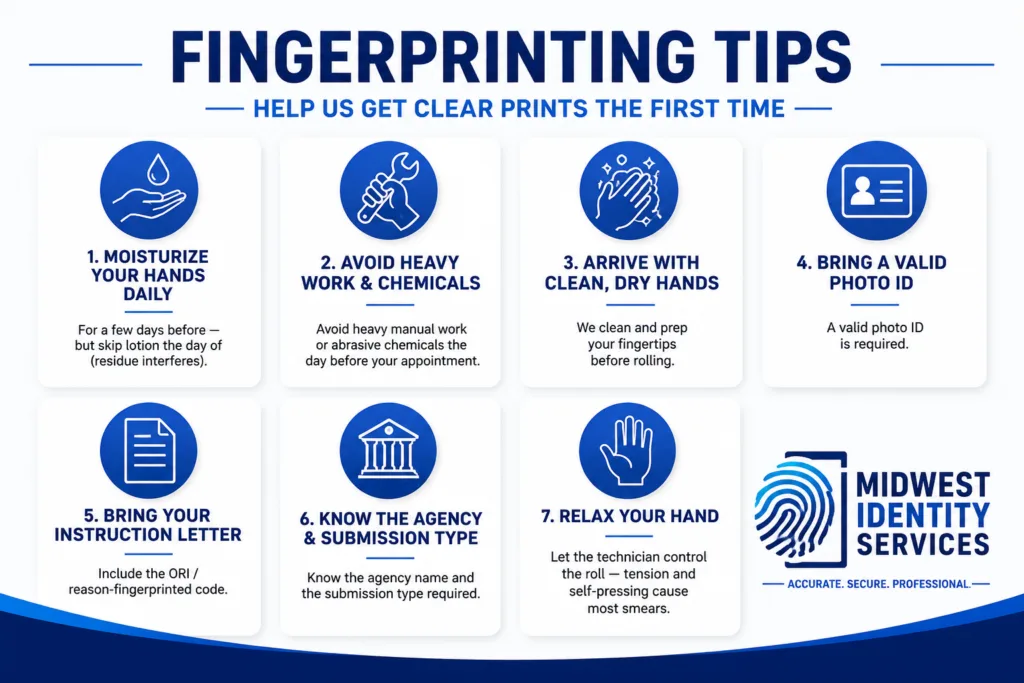
What if my fingerprints get rejected anyway?
A rejection isn’t the end of the road, and you don’t have to figure it out alone:
Rejected Somewhere Else? We Can Help.
We’re fingerprinting specialists, and we regularly work with people whose prints were rejected by another provider. Bring us your rejection notice — we re-capture your prints using proven techniques for difficult cases, and they go through successfully. A rejection somewhere else doesn’t mean you’re stuck.
And if a print we capture is ever rejected for quality, we simply re-roll and resubmit it.
A small number of people have naturally faint ridges that no method can fully fix. There’s still a path: agencies generally allow a second attempt, and the FBI’s guidance notes that if prints are rejected twice for quality, many agencies will accept a name-based check instead. We document each attempt and walk you through it. If you’ve been rejected before, tell us when you book your appointment and we’ll take extra steps to get a clean capture.
FAQ
Q: Can you redo fingerprints that were rejected by another provider?
A: Yes. We regularly help people whose prints were rejected elsewhere. Bring your rejection notice and we’ll re-capture them using proven techniques for difficult prints, so they go through successfully.
Q: How many times can fingerprints be resubmitted?
A: You can typically resubmit after a quality rejection. Per FBI guidance, if prints are rejected twice for quality, many agencies will accept a name-based background check in place of fingerprints.
Q: Can dry skin cause a fingerprint rejection?
A: Yes — dry or cracked skin is the most common cause of low-quality prints. Moisturizing in the days before (but not the day of) noticeably improves capture quality.
Q: Why do my fingerprints keep getting rejected?
A: Usually worn or dry ridges, or too much pressure during the roll. Electronic Live Scan fingerprinting checks quality at capture and re-rolls on the spot, which is why it rejects far less often than mailed ink cards.